I have heard similar proposals … In fact he said he was going to treat all value above 1 to be overexposed which is completely not true if you are using Filmic.
Ok, let me explain myself more vividly.
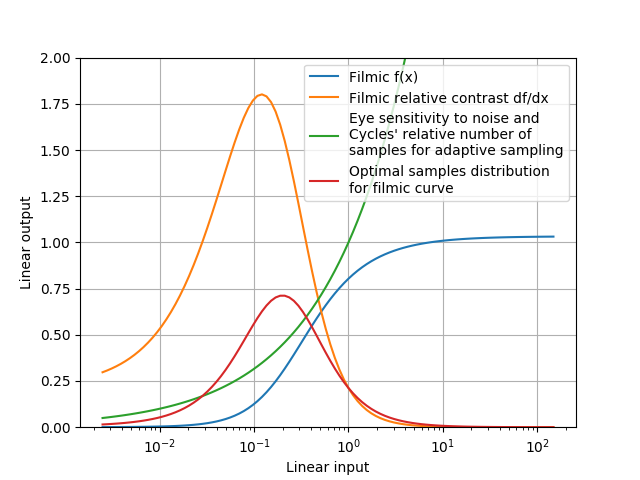
Here’s a typical filmic curve f(x), it transfers linear rgb to linear rgb, which then in turn will be encoded to sRGB image by using gamma-compression, but decompressed back by the display before showing it to you. I’ll deliberately ignore this sRGB compression-decompression part - BT.601 and BT.709 transform functions were invented only for more effective image compression, and that’s why it is irrelevant here.
Filmic curve is there to compress wide lightness range into a narrow range of what’s your display is able to reproduce. It’s similar to what all digital cameras do, and in turn similar to what all film cameras did in the past. Filmic compresses the lightness range by lowering contrast of darks and highlights. Since the resulting contrast here is 5-8 times lower, we can get away with 5-8 times higher noise in input linear values, which means 25-64 times lower sample count.
There’s also eye’s sensitivity function - it is subjective and thus not easily measurable, but overall it is assumed as sqrt(x). Cycles adaptive sampling follows this function when deciding if it has reached noise threshold. As you can see, it demands higher number of samples in highlights, even in zones where it will be compressed by filmic.
That’s why it is important to take the final color transform into account, but doing so accurately requires also taking into account Blender compositor and all downstream transforms. It’s possible to implement, ofc, but it also can get computationally more expensive than adding some samples. That’s why it is unpractical. What actually can be done, is assuming color transform function a bit more accurately, since it can bring huge benefits in render quality/time. For example, if we assume filmic transfer function, the optimal sampling count will be much lower in highlights (as shown in the picture). My suggestion actually was less radical - to limit sampling rate to a plateau in highlights, so that it wouldn’t get disproportionally more samples than mid-tones.
That’s on color transforms from the point of light intensities. There’s also a possibility to benefit over lower eyes chromatic sensitivity - but that’s another long story =)